

The Shawl That Must Be Earned, Not Bought

Some textiles are bought. Others are inherited. And then there is the Tsüngkotepsü — a shawl that had to be won.
Among the Ao Naga tribe of Nagaland, legend holds that a man could not simply choose to wear this shawl. He had to earn it — through war, through victories in battle, through acts of bravery significant enough to be recognised by his community. It wasn't a garment you put on. It was a garment you were finally permitted to.
The shawl itself is unmistakable: bold black and red stripes, split at the centre by a single band of white. Woven into that structure are symbols that read almost like a record — the sun, the moon, the stars, each one standing in for victory and renown. Tigers, bisons, lions appear too, carrying the weight of physical power and warrior valour. And amid them, the hornbill — a bird so central to Naga ceremonial life that its feathers still adorn traditional costumes today — takes its place on the cloth as a mark of honour. Spears, arrows, daos: the tools of the warrior, woven rather than wielded, but no less a statement of strength.
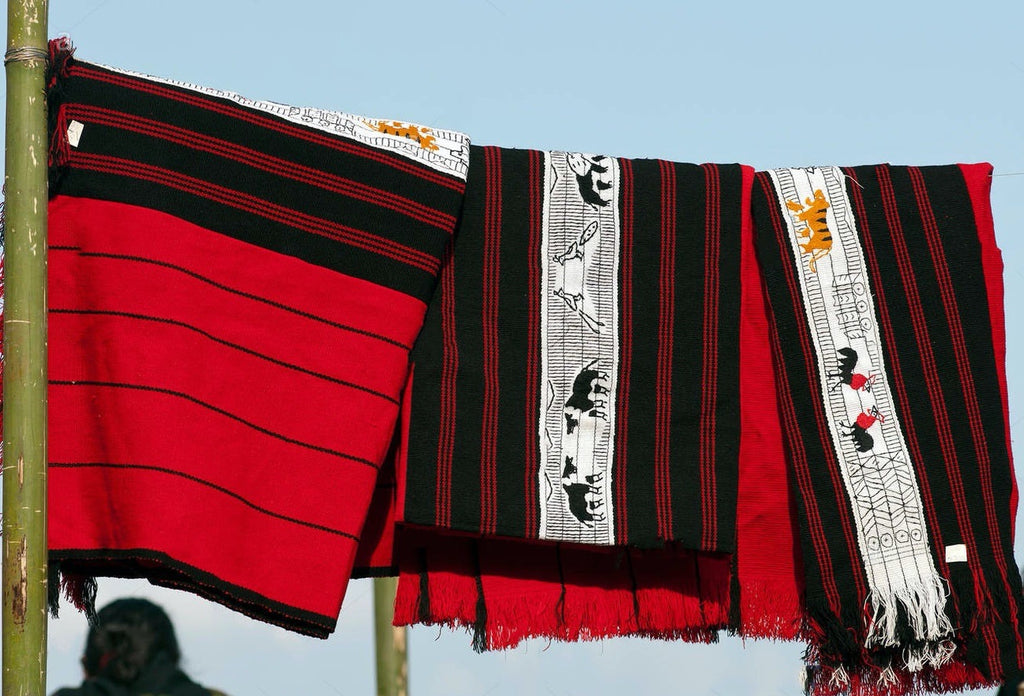
For generations, this was a shawl reserved strictly for men who had earned it — a woman wearing it would once have been unthinkable, a clear taboo. That boundary has since loosened. Today, the Tsüngkotepsü is worn by men, women, and children alike, its meaning widening even as its history stays woven into every stripe.
That is what makes the Tsüngkotepsü unlike almost anything else woven anywhere in the world. You cannot walk into a shop and buy your way into it. You cannot inherit the right to wear it, only the fabric itself, and even then, it arrives carrying the memory of someone who bled and stood their ground for the privilege. Every stripe, every hornbill feather, every small dao stitched into the weft is really a sentence in a much older language — one that says: this was earned, this was survived, this mattered enough to be remembered in cloth. Perhaps that's the quiet lesson every handwoven textile is trying to teach us, if we're willing to listen — that the things worth wearing were never really about the fabric at all. They were about what it took to deserve them.


