

Assam Silk - A Terminology Breakdown

Assam silk is an umbrella term — a convenient shorthand for three entirely different textiles that happen to share a homeland. Paat, Eri, and Muga. Say the words together and they sound like siblings. Hold the fabrics in your hand and you'll see they're nothing alike.
Paat is white, almost bridal in its purity. Muga glows honey-gold, as if it has stored a little of Assam's sun in every thread. Eri is quieter still — cream, coarse, unassuming — except in Kokrajhar, where a rare red variety exists almost like a secret the district keeps to itself.
Three silks. Three temperaments. Let us walk you through each.
Luxurious Muga
Muga is the pride of Assam, and it earns that title honestly — it is found nowhere else on earth. The silkworm behind it is wild, untameable in the way of things that refuse domestication. In Upper Assam, it feeds on the Som tree; in Lower Assam, on the Suala. A handful of secondary host trees exist too, and depending on which one nurtures the worm — and which season the worm is reared in — the resulting silk shifts in colour and character.
What doesn't shift is the quality. Muga is glossy, fine-textured, and famously durable — durable enough, in fact, to outlive its owner. My grandmother passed some of her Muga silks down to me, pieces from her own wedding trousseau. Decades of rough handling and home washing — this was long before dry cleaning existed — have left them a little frayed at the edges. And yet they still hold their shine. That's what an heirloom is: something time tries to wear down and mostly fails.

Gentle Eri
Eri — sometimes called Endi or Errandi — may be the most underrated of the three. It doesn't try to dazzle. Its texture is rustic, its sheen muted, its hand dense and a little coarse. But look closer and you'll find one of the gentlest stories in textile making.
Eri is spun only after the pupae inside have completed their transformation into moths and left the cocoon on their own terms. Only those open-ended, naturally vacated cocoons are used. This is why Eri carries another name: Ahimsa silk, non-violent silk. No life is taken to make it.
That gentleness comes at a cost — Eri is more labour-intensive and more expensive to produce than conventional silk — but it repays that cost many times over. Every part of the cocoon becomes usable yarn and, eventually, fabric. Long before "upcycling" was a word we needed, Eri was already practising it.
 And then there's the quality that feels almost like a small miracle: Eri is isothermal. Cool against the skin in summer, warm against it in winter. It carries silk's elegance, cotton's ease, and wool's warmth all at once — and the more it's worn, the softer it becomes. Few fabrics reward years of use the way Eri does.
Read - The Story of Eri.
Glossy Paat
Paat is Assam's own mulberry silk — domestic, where Muga is wild. The larvae responsible for it feed on the leaves of the indigenous bogori, or jujube, plant, and are known locally as Nuni — which is why Paat is often called Nuni Paat. In its finished form, the silk is a natural white or off-white, prized for its softness, its durability, and a glossy quality some can only describe as luminous.
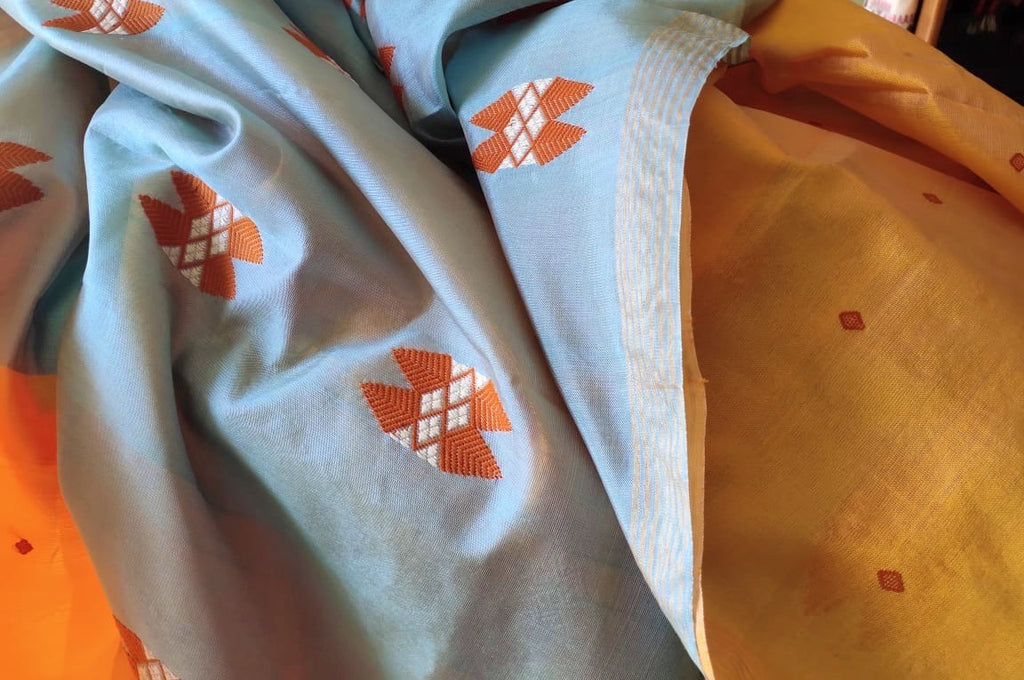
Before it becomes the fabric most people recognise, Paat passes through a raw stage called Kesa Paat — delicate, translucent, almost weightless. Kesa Paat still carries sericin, the natural gum that protects the fibre through processing. That gum stays on until the yarn is boiled in soap and water, a process that strips away as much as 30 percent of its weight and leaves behind something soft, lustrous, and impossibly light. It's this stage that gives Kesa Paat its dreamlike, almost weightless drape — as though the garment is barely there at all.


